A tracked robot with an arm working beside two field technicians on a solar site

Solar operations robotics · India and the Middle East

Solar farms that stay at full output

Autonomous robots that clean panels without water, find cracked and overheating modules, and swap them out. Built for desert sites, working the night shift.

Early stage · Pilot partner list open for the 2027 dry season
Waterless cleaningThermal inspectionCracked-glass detectionHot-spot mappingModule swap-outsRow-by-row logsNight shifts

05:40, a dry morning in western Rajasthan

The sun is up. The panels are already dusty again.

A site manager walks the first block before the heat starts. Yesterday's dust storm left a brown film across thousands of modules. The cleaning crew is booked for next week. The water tanker is late. Somewhere in block 14, one module has a cracked cell that has been running hot for a month, and nobody knows yet.

None of this is a building problem. The farm was built well. It is a keeping problem. Utility-scale solar is designed to run for decades, and most of the money is earned in those years of quiet operation. That is the part we want to automate.

The problem

Three things quietly take output away from a desert solar farm

  1. 01 — Dust

    Soiling comes back faster than crews can clean

    In the Thar, Kutch and across the Gulf, fine dust settles on glass every day and storms can coat a whole site overnight. Dirty glass lets less light through, so the same sun makes less electricity. Most sites clean on a fixed calendar because labour and water are scheduled weeks ahead.

  2. 02 — Water

    The usual fix uses the one thing a desert lacks

    Hand washing and tractor washing both rely on trucked, often treated water. On a large site that is a steady stream of tankers, on roads built for construction traffic, in regions where groundwater is already under pressure.

  3. 03 — Defects

    Broken modules hide in plain sight

    A cracked cell, a failed bypass diode or a hot spot rarely trips an alarm. It shows up as a small dip in one string, mixed in with weather and dust. Drone thermal surveys catch some of it a few times a year. Then a technician still has to find the module, carry a replacement out and swap it in the heat.

What the robot does

One machine, three jobs, every row

Clean

Waterless cleaning

A soft rotating brush and directed air move along each table and lift dust off the glass. No water, no detergent, no tanker. The robot cleans as often as the dust needs, rather than when a crew is free.

  • Dry brush and air, no water
  • Cleaning frequency set by measured soiling
  • Works on fixed-tilt tables and single-axis trackers
Inspect

Module-level inspection

While it cleans, the robot looks at every module up close with a visible camera and a thermal camera. It flags cracked glass, browned cells, broken frames, soiling patches and modules running hotter than their neighbours.

  • Visible and thermal images per module
  • Each finding pinned to block, row, table and position
  • Same module photographed on every pass, so change is visible
Swap

Module swap-outs

When a module is confirmed faulty, a robot carrying spares and an arm removes it and fits a replacement. A technician approves each swap and handles the electrical sign-off, since that stays with qualified people.

  • Carries spares down the row
  • Human approval before any module is removed
  • Old module tagged and returned for warranty claims
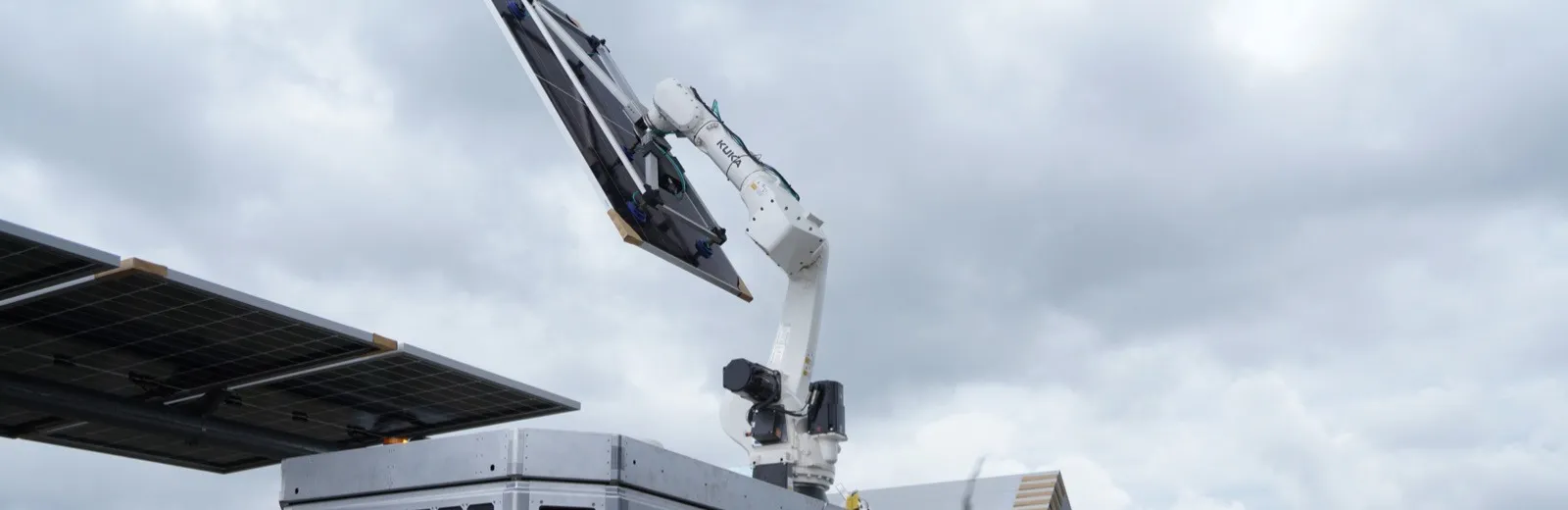
A robot arm lifting a solar module above a row of installed panels under a grey sky
Placeholder photo of a robot arm handling a module. Our own field images replace it once the first unit is outdoors.

How it works

A night shift, from dusk to the morning report

  1. 17:00

    Late afternoon: thermal pass

    Robots charge in a shaded dock through the hottest hours. While modules are still producing, they drive their assigned rows with the thermal camera, because hot spots only show up under load.

  2. 19:30

    After dark: clean and photograph, row by row

    The robot reaches across each table, cleans the glass and takes a close photo of every module under its own lights. Cool glass at night is kinder to coatings.

  3. 02:00

    Faults get a second look

    Anything suspicious is checked again from a different angle. Low-confidence findings are marked for a human to review, never acted on alone.

  4. 05:00

    Back to dock before sunrise

    Robots return, recharge and offload data. Approved swap-outs are queued for the next shift.

  5. 06:00

    The site team gets one report

    Rows cleaned, modules flagged, photos for each finding and a list of swaps waiting for approval. Exports to the tools the site already uses.

Sample site plan: robot route through four rows, with a dock and two flagged modules DOCK ROW AROW BROW CROW D HOT SPOT · A-04CRACK · C-06
Sample route for one robot across four rows. Real routes follow each site's layout and access lanes.

What you receive

The morning report your site team actually reads

One page per shift. Every finding has a location, a photo pair and a suggested action. This is a mock-up with made-up data, so you can see the shape of it.

Sample

Shift report · Block 14

Example Solar Park 2 (fictional) · Night of 11 to 12 March

Rows cleaned
38 of 38
Modules imaged
6,080
Findings
5
Water used
0 L
LocationFindingConfidenceSuggested actionStatus
B14 · R07 · T03 · P11Hot spot, about 18°C above neighboursHighSwap moduleAwaiting approval
B14 · R12 · T09 · P02Cracked front glassHighSwap moduleAwaiting approval
B14 · R19 · T01 · P07Bird droppings, not removed by dry brushMediumManual spot cleanAssigned to crew
B14 · R25 · T05 · P14Possible cell browningLowHuman reviewReview
B14 · R31 · T08 · —Loose table clampMediumMechanical checkAssigned to crew

Sample data. Figures, site and findings are invented for illustration.

Technology

Four layers, designed for heat, sand and long rows

A solar farm looks tidy from above, but up close it is uneven ground, sand drifts, tables that move with the sun and kilometres of nearly identical rows. The robot has to know exactly which module it is looking at, every time, without a person watching. We split the problem into four layers.

  1. Layer 0

    Platform

    An electric tracked base sized for access lanes, with sealed drives, a sun-shaded body and batteries managed for high ambient temperatures.

  2. Layer 1

    Tools

    A dry cleaning head that follows the tilt of each table, and an arm with suction grippers for lifting and placing modules.

  3. Layer 2

    Perception

    Visible and thermal cameras, with on-board models that detect cracks, hot spots and soiling, and match each module to the site's as-built map.

  4. Layer 3

    Planner

    Fleet software that decides which rows need cleaning tonight, keeps robots out of each other's way and turns findings into a work list for the site team.

We are building Layers 0 and 1 first, because nothing else matters until a robot can work a row reliably for a full night. Perception and planning are developed alongside, using images from every pass.

Design targets

Built around desert conditions from day one

These are the conditions we design and test against. They are goals for the first field unit, and we will publish what it actually achieves.

Heat
Docks in shade by day, works at night when air and glass are cooler. Electronics sealed and cooled for summer peaks.
Sand
Tracks rather than wheels for soft ground and drifts. Sealed joints and filtered air intakes.
Water
None for routine cleaning. Stubborn spots go on the crew list instead of being scrubbed harder.
Glass
Soft brush with controlled pressure, so the anti-reflective coating is not worn away. Pressure limits set per module type.
Layout
Fixed-tilt tables and single-axis trackers. Works from the existing access lanes, no rails to install on each row.
Safety
Stops for people and vehicles, geofenced to its assigned blocks, and never touches electrical connections.
Line drawing of the robot beside a tilted solar table, with callouts for the cleaning head, cameras, spare modules and tracks DRY CLEANING HEAD VISIBLE + THERMAL SPARE MODULES ELECTRIC TRACKS brush + air, follows table tilt every module, every pass for overnight swap-outs for sand and soft ground
Concept drawing. Proportions and parts will change as the first unit is tested.

Where it is used

Starting where the sun is strongest and the dust is worst

India

Rajasthan and Gujarat hold some of the largest solar parks in the world, including Bhadla near Jodhpur and the Khavda renewable energy park in Kutch. Both regions are dry, dusty and short of water.

  • Thar Desert sites in western Rajasthan
  • Kutch and north Gujarat
  • Large parks in Karnataka and Andhra Pradesh in the dry season

Middle East

The UAE, Saudi Arabia and Oman are building very large solar plants in hot desert, where sandstorms and high temperatures are normal working conditions, and fresh water usually comes from desalination.

  • UAE: Dubai and Abu Dhabi utility-scale plants
  • Saudi Arabia: national renewable programme sites
  • Oman and the wider Gulf

Site types

We start with ground-mounted utility-scale sites, where rows are long and regular and the same work repeats tens of thousands of times.

  • Fixed-tilt tables
  • Single-axis trackers
  • Sites of roughly 50 MW and larger

Compared with today

How the work gets done now, and what changes

Every option below has a place. Our view of where each fits, written plainly.

Manual crewsTractor-mounted washersRail-mounted cleaning robotsSolarTended
WaterUsually yesUsually yesMostly dryDry
Cleaning frequencyScheduled weeks aheadLimited by machines and driversDaily possibleSet by measured soiling
Install per rowNoneNoneOne unit and rail per rowNone, shares access lanes
Module inspectionVisual, occasionalNoUsually noEvery module, every pass
Module replacementYes, by handNoNoRobot-assisted, human-approved
MaturityProvenProvenDeployed at many sitesEarly stage, pre-pilot

Why now

The sites got bigger. The tools did not.

  1. Gigawatt parks are now normal

    Both India and the Gulf have moved from single plants to parks measured in gigawatts. At that scale, a small loss on every module is a large loss for the site, and walking every row by hand stops being practical.

  2. Water is a cost and a reputation risk

    Trucking water into a desert to wash glass is expensive, and buyers, lenders and local communities are asking harder questions about it.

  3. Robots can now see well enough

    Thermal cameras, rugged edge computers and vision models have become cheap and capable enough to inspect every module on every pass, on board, without a data link.

  4. The fleet is ageing

    Many early utility-scale sites are reaching the age where modules crack, degrade and need replacing. Finding and swapping them one at a time is slow work in the heat.

Honest limits

What we are not, and what we cannot do yet

  • We have no robots on a customer site today. We are early stage and looking for the first pilot partners.
  • We do not do electrical work. Isolation, string testing and sign-off stay with your qualified technicians.
  • Dry cleaning will not remove everything. Bird droppings, cement-like crusts after rain and some industrial grime need water or hand work. We flag them instead.
  • We are not starting with rooftops. Commercial roofs, carports and floating solar are out of scope for now.
  • We are not an asset manager or an O&M contractor. We supply the robots and the data. Your team, or your O&M partner, stays in charge of the site.
  • We will not publish performance numbers we have not measured. Any figures will come from pilot sites, with the method shown.

Pilot partners

Become a pilot site for the 2027 dry season

We are looking for a small number of site owners and O&M teams in India and the Middle East to run early units with us. You get a say in what we build. We get honest feedback from a working site.

What we ask from you

  • Access to one block of a utility-scale site
  • A site contact for safety induction and permits
  • As-built layout and module datasheets
  • Plain feedback, including when it does not work

What you get

  • Cleaning and inspection on the pilot block
  • Every report and image from your site
  • Early say on features and integration
  • First option on a full deployment

Tell us about your site

We reply within two working days. No newsletter unless you ask. See our privacy notice.

Questions

Questions site teams ask us

Can you buy a robot today?

No. We are early stage and building the first field unit. Right now we are talking with site owners who want to run a pilot with us, so the product is shaped by real sites.

Will a dry brush scratch the glass or wear the coating?

That is the first thing we test. The brush is soft, pressure is controlled per module type, and we check coating wear on test glass before any robot touches a live site. If a module maker's warranty rules out a method, we follow the warranty.

Why work at night?

Glass and electronics run cooler, the robot does not shade panels while they are producing, and site crews are not in the way. Thermal inspection works differently at night, so some checks run at dusk or dawn when modules are still warm.

Who decides when a module is replaced?

Your team. The robot suggests a swap with photos and a reason. A technician approves it, isolates the string where needed and signs off. The robot only does the lifting and placing.

Does it work on trackers?

Yes, that is part of the design. Trackers are parked at a set angle during the shift so the cleaning head and arm can reach each module the same way every time.

What happens in a sandstorm?

Robots return to the dock when wind or visibility passes a set limit. After the storm, the planner moves the worst-hit blocks to the top of the next shift.

Where does the data go?

Images and reports belong to the site owner. During a pilot they are shared with you through a simple web export and can be deleted on request. We do not sell site data.

How is this priced?

Not decided yet. We expect a service fee per megawatt rather than a large upfront purchase, and pilot terms will be agreed site by site.

Let the robots take the night shift

If you run solar in a desert, we would like to hear what slows your site down.